Thursday, June 19, 2008

What gives a Guitar its Tone?

Hey guys,

I've come across an excellent set of articles all about guitar tone. Have you ever wandered what makes a guitar sound the way it does? These articles deal with exactly that. Each part of the guitar affects its tone. The author cleverly discusses these parts individually. They are:

  1. The Strings
  2. The Neck
  3. The Body
  4. The Bridge
The author explains these concepts fundamentally from the types wood to the pickups. I find that the basic idea with the tone of any instruments or a room, is simply that hard surfaces (eg. a brick wall) reflect high frequencies whilst soft surfaces (eg. a soft sofa) absorb the high frequencies.

Using light as an analogy to sound works well because they are both waves and both reflect and refract off materials. Think of hard surfaces like a mirror - they reflect almost all the light. Soft or rough surfaces diffuse the sound, similar to how a glazed bathroom window diffuses light.

You will notice that guitar tone is governed by the same fundamental rules. Hard materials brighten the tone and soft materials seem to boost the low frequencies, creating a warmer sound. All the same, the above mentioned articles are definitely worth a read because they go into way more detail about which woods or materials create which sound.

Other posts you might find interesting:

Microphone Review: Shure SM57 Microphone
Speaker Placement
High There?!
Panning for Gold
Audio Recording in Ubuntu Studio - Part 1: Plan your Project

Wednesday, June 4, 2008

Audio Recording in Ubuntu Studio - Part 1: Plan your Project

Okay, so you've decided that you want to record a song from your home. You've also decided, like the rest of us cheapos, that you are going to use freeware. If you haven't yet decided, I recommend you use Ubuntu Studio (for why see here). Ubuntu Studio is armed with these great programs: the Best Programs in Ubuntu Studio.

When recording a project you never want to go in Swinging Blindly (especially if this is your first time). So here are a few steps to ensure that your project doesn't run out of steam half way through.

Firstly, you need to understand that there are four parts to any recording project:

  1. Preparation (setting up tempo, ensuring the song arrangement is finalised, etc.)
  2. Recording (getting your instruments' sounds into your computer)
  3. Mixing (Getting your levels right, panning each instrument, etc.)
  4. Mastering (Getting your track to sound professional)
With these steps in mind we can set up a flow diagram leading us through the project from start to finish. As an example, I plan to record a cover version of Sunday Bloody Sunday by U2. The flow diagram for my project is show below.
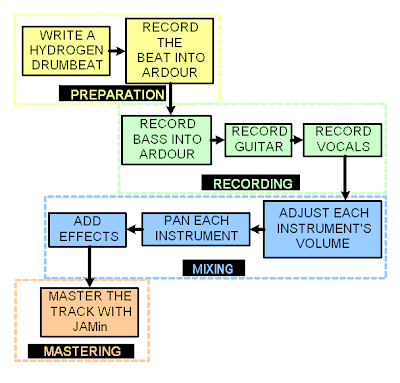
You can see from the figure that every instrument has its place in the recording process. It is important to put the drum track down first, even if you are using real drums. This is because it sets up the tempo for the song and provides a nice backbone for the other instruments to play along to. It is imperative that you play to a metronome, it'll be hard at first but it will always make the project easier and the song tighter. Yeah, I know...you're too cool for a metronome... you think it will destroy the emotion of the song... for the people who think that (like I did) - shut up, and listen 'cause I know, first hand, that you need a metronome.

I plan to create a blog post for every step in the process over the next few weeks. So stay tuned for the basics as well as the not-so-basics of hydrogen, recording guitar, bass, vocals, mixing, mastering, etc...etc...etc... Exciting times await!

Check out the next part of this project: Audio Recording in Ubuntu Studio - Part 2: Record a Hydrogen Drumbeat

Other posts you might find interesting:
Audio Recording in Ubuntu Studio - Part 2: Record a Hydrogen Drumbeat
Audio Recording in Ubuntu Studio - Part 3: Adding Effects to the Ardour Drumtrack
Beginner's Guide to Ubuntu Recording
What Exactly is Mastering For?
Speaker Placement

Monday, June 2, 2008

Sunday Bloody Sunday Hydrogen Drumbeat

U2's song, Sunday Bloody Sunday has quite a complicated drumbeat, so I decided to make a Hydrogen song out of it. I have done this for three reasons:

  1. So that drummers can look at the Hydrogen drumbeat patterns and work out how to play it.
  2. So that guitarists can play along to a decent drumbeat without getting their hands dirty.
  3. Because its just too cool.
I used the YamahaVintageKit by ArtemioLabs (Downloadable from here). Note that you will need this drumkit to play the Hydrogen song (.h2song format). The song is available from the links below:
Other posts you might find interesting:
How to make a Hydrogen Drumkit
Making a Roll Sound Realistic
Multiple Outputs for Hydrogen
My Attempt at a Hydrogen Drumkit
Hydrogen Drumkits